
Short answer: not always, but often enough that it’s worth checking. If the Home Report is clean and the property is modern, you can usually proceed without a damp survey. If there’s any sign of a damp problem, or the house is older or altered, a professional damp survey is normally money well spent.
If you’re buying a house in Scotland in 2026, you’ll almost certainly see a Home Report before you offer. That’s helpful, but it doesn’t always give you a clear diagnosis when there’s damp, mould growth, or any other type of damp or timber problem hiding behind finishes.
A damp survey is a specific inspection designed to identify moisture-related defects, explain the likely cause of the damp, and set out sensible next steps. It also tells you whether to walk, negotiate, or proceed, and what to budget if you do proceed.
Below is a practical guide to when you need a damp survey, what it includes, what the damp survey cost looks like, and how to choose a qualified damp surveyor in Scotland.
Table of Contents
How the Scottish Home Report fits in
In Scotland, most properties marketed for sale come with a Home Report. It contains three documents: the Single Survey and valuation, the Property Questionnaire completed by the seller, and the Energy Report, which includes the EPC. A handful of sales are exempt, including most new builds and auction sales.
The Single Survey is a visual inspection carried out by a chartered surveyor. Only surveyors registered with or authorised to practise by RICS can produce one. It gives each part of the property a condition category from 1 to 3:
Category 1: no immediate action or repair needed
Category 2: repairs or replacement needed in future, but not urgently
Category 3: urgent repairs or replacement needed now
Those categories are applied element by element, not to the house as a whole. A single Category 3 doesn’t mean the property is a wreck.
Where this matters for damp: the Single Survey can indicate signs of damp, dampness, staining or decay, and it does specifically assess damp and timber defects. What it isn’t designed to do is diagnose the source of moisture or specify the right solution in detail. Think of it as an early warning system rather than the final word, which is why a Category 2 or 3 against damp so often ends with “further investigation recommended.”
One more thing worth knowing. A Home Report is valid for 12 weeks from the date of the survey and is generally treated as out of date after that. If a property has been on the market since the winter, its assessment of dampness may predate a full season of driving rain, and damp problems that weren’t visible in November can become apparent by March.
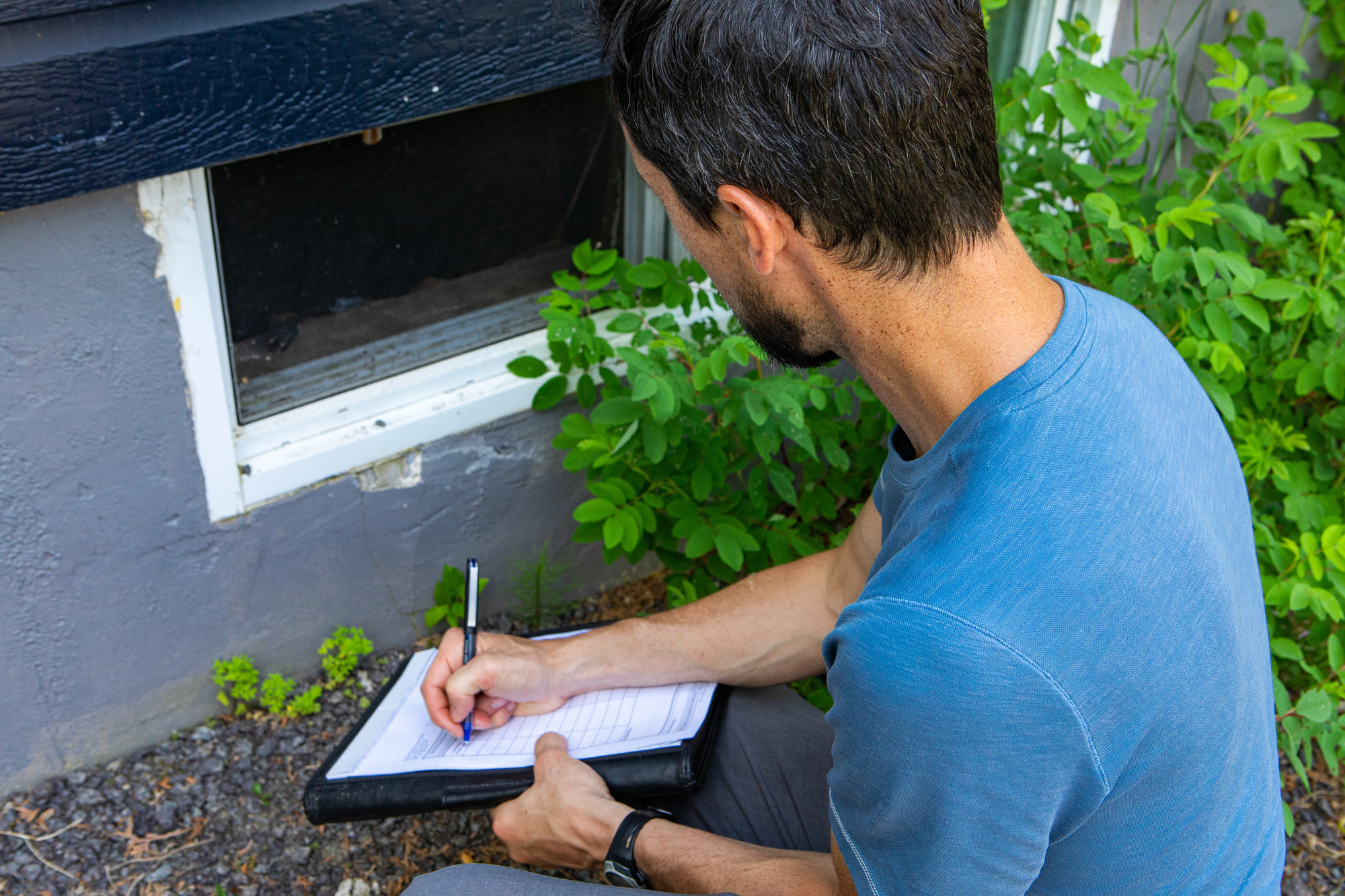
When you should get a damp survey done
You don’t automatically need a professional damp survey for every purchase. But you should strongly consider it if any of the following apply:
1) The Home Report flags dampness, rot, or infestation
If the Single Survey mentions dampness in buildings, rot, timber decay, or recommends further investigation, it’s a classic trigger to book a property survey that focuses specifically on damp and timber.
2) You can see mould, musty smells, or persistent condensation
Visible mould, a lingering musty odour, condensation and mould on windows or cold corners, or “always damp” areas can indicate a ventilation/condensation issue, or it can be disguising something else. A damp surveyor can help you identify the type of damp rather than guessing.
3) The property is older, altered, or has “typical” Scottish risk factors
Older homes, sandstone properties, solid walls, retrofits, and homes with changed ground levels outside can be more prone to moisture problems. If you’re buying a “character” home, a specific type of survey can be a sensible investment.
4) You’re seeing tide marks, blown plaster, or salt deposits
These can be associated with rising damp (though not always), and it’s exactly where a surveyor will investigate the cause of the damp and whether it’s actually caused by rising damp or something else.
5) You want to negotiate, not gamble
A clear survey report gives you evidence to negotiate the purchase price, ask for remedial works, or decide to walk away.
What type of damp problem might it be?
A good damp survey doesn’t just say “damp”, it should explain the likely type of damp problem, the mechanism, and the source of moisture.
Condensation
Condensation is often linked to ventilation, occupancy, cold bridging, and heating patterns. It commonly leads to mould growth on cold surfaces. A proper inspection considers airflow, extraction, and lifestyle factors, and explains how to manage damp and mould without over-treating the building. Condensation is the most common cause of damp in modern homes, and the one most frequently misidentified as something worse.
Penetrating damp
Penetrating damp comes from water getting in laterally, for example, defects in roof coverings, gutters, pointing, flashings, or cracked render. It can appear as localised staining or damp patches after rain. This is a very common damp problem in the real world, and it’s why “one-size-fits-all” treatments can be risky.
Rising damp
Rising damp is moisture travelling up from the ground through masonry by capillary action. It’s frequently discussed, sometimes over-diagnosed, and occasionally very real. A competent damp surveyor will check whether a functional damp proof course exists, whether external ground levels bridge it, and whether the symptoms truly match rising damp rather than salts, condensation, or leaks.
That distinction matters commercially as well as technically. Rising damp treatment means installing a new chemical damp proof course, which isn’t cheap and won’t help at all if the real source is a bridged DPC, a leaking downpipe or condensation. Diagnosis first, damp treatment second.
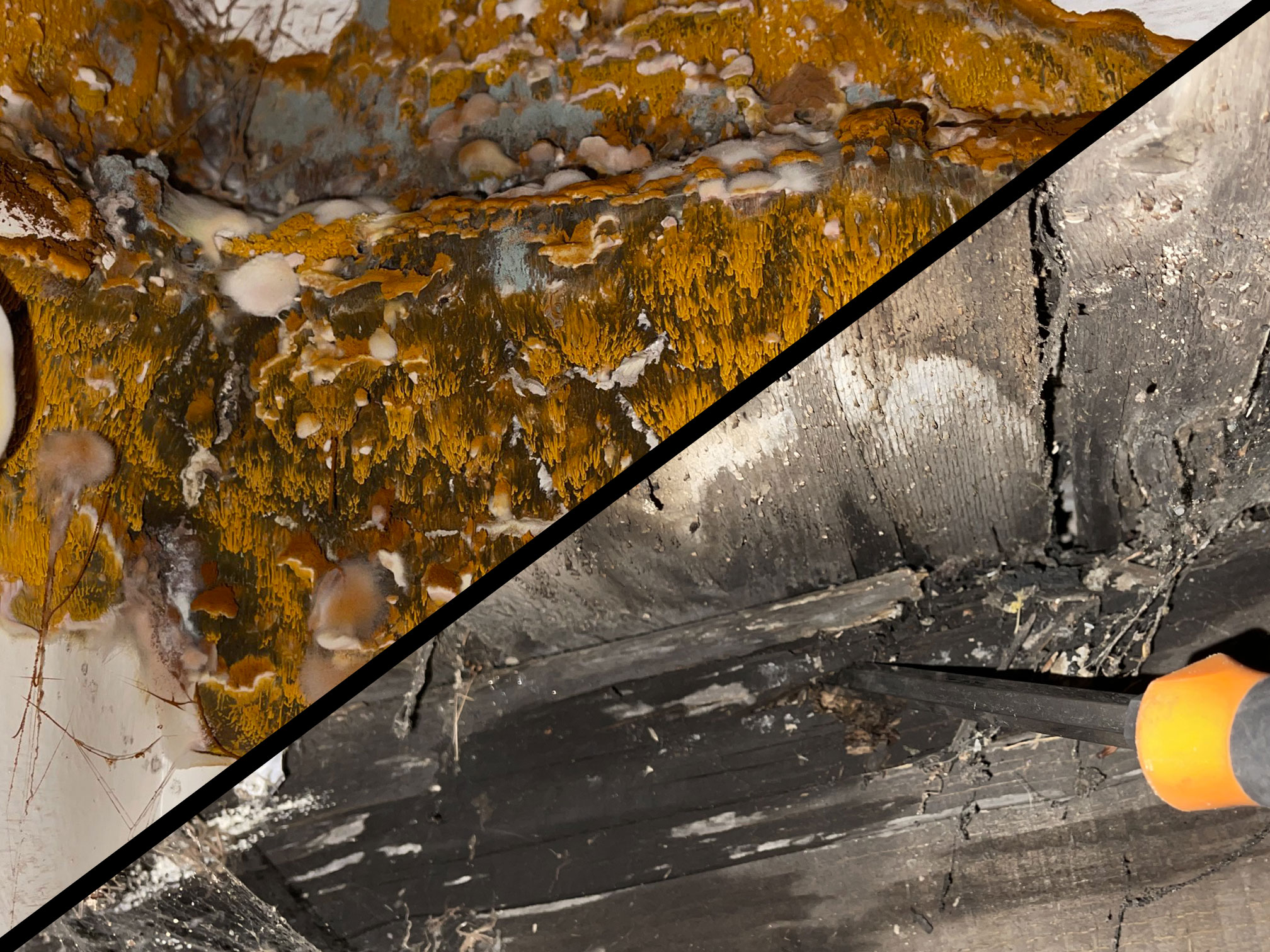
Dry rot: the Scottish damp problem
Dry rot (Serpula lacrymans) deserves its own section, because it’s disproportionately common in Scotland’s older housing stock, particularly sandstone tenements with timber-lined solid walls, joist ends built into damp masonry, and sub-floor voids never designed for modern ventilation.
Like wet rot, dry rot needs a sustained source of moisture to take hold: a long-running leak, a failed gutter, a blocked airbrick, penetrating damp through failed pointing. The difference is what happens next. Dry rot can travel through masonry to reach fresh timber, which makes it more serious than wet rot and considerably more expensive to put right.
The practical point for buyers is that dry rot hides. It develops behind panelling, under floors and inside voids, exactly the places a visual Home Report inspection can’t reach, and exactly where moisture levels go unchecked for years. If you’re buying a tenement flat or a pre-1919 property with any history of water ingress, this is the strongest single argument for a damp and timber survey rather than a basic damp inspection.
What is a damp and timber survey, and what does it include?
A damp and timber survey (sometimes followed by a damp and timber report) looks at moisture issues and how they affect structural materials, especially timber.
A thorough surveyor will inspect likely moisture entry points, internal finishes, subfloors (where accessible), and risk areas such as chimney breasts, bay walls, and bathrooms. They’ll usually work from both outside and in, following the water rather than the symptom.
Typical tools and methods can include:
- A calibrated moisture meter (often called a damp meter) for surface readings, though it’s worth knowing these are calibrated for moisture in timber, not masonry. On plaster and stone the readings are indicative rather than definitive, and salt contamination can push them up dramatically. A competent damp surveyor interprets the meter alongside the visual evidence and the building’s construction, not instead of it.
- Visual checks for salts, staining and failed finishes
- Checks on damp walls, skirtings and joinery condition
- Assessment of moisture levels in timber where accessible
- Ventilation and extraction assessment, particularly in kitchens and bathrooms
- Consideration of how building defects may cause damp: rainwater goods, pointing, ground levels, bridging
Where timber is affected, the damp and timber report should cover dry rot or wet rot where present, and be clear about what is genuinely required versus unnecessary work. The aim is proportionate remedial treatment based on evidence, not assumptions.

How much does a damp survey cost in Scotland in 2026?
The damp survey cost depends on property size, access, and whether you need a simple damp inspection or a full damp and timber report.
As a guide for 2026:
- £150–£300 for a standard damp survey of a typical two- or three-bedroom house, producing a written survey report with findings, diagnosis and recommendations
- £300–£600+ for larger properties, multiple or complex damp problems, or a combined damp and timber survey
A sensible way to think about the damp survey cost: the fee is small next to the cost of the wrong fix. An unnecessary damp proof course can run to a couple of thousand pounds and won’t touch a condensation problem that a few hundred pounds of ventilation work would have solved. For context, broader house survey costs in 2026 run well into the hundreds depending on level and property value.
We’ve broken the numbers down in more detail in our full guide to damp survey costs in Scotland, including how location, property age and access affect the price.
How to choose a qualified surveyor (and avoid the common traps)
Not all damp reports are equal. When you’re buying, you want independence, clarity, and diagnostic quality, not a sales script.
Look for relevant qualifications and trade standards
The Property Care Association (PCA) is the UK trade body representing damp and timber specialists, and it provides the training and industry qualifications most damp surveyors hold. There are two worth knowing:
- CSTDB: Certificated Surveyor of Timber and Dampness in Buildings. Covers timber, damp and legal/health and safety modules. For a pre-purchase damp and timber survey in Scotland, this is the qualification you want, because so much of the risk here is timber decay.
- CSDB: Certificated Surveyor of Dampness in Buildings. Covers dampness in buildings, but not timber to the same depth.
You’ll also see CSRT (Certificated Surveyor in Remedial Treatments) on plenty of websites and business cards. That’s the former name for CSTDB; it was renamed in 2018, and anyone holding CSRT is a properly certificated surveyor. It’s just no longer the term to go searching for. If a firm still advertises certificated surveyors in remedial treatment, that’s fine. Just ask when they qualified and what modules they hold.
Separately, CSSW (Certificated Surveyor in Structural Waterproofing) covers below-ground waterproofing. Relevant for basement conversions, not for a general damp inspection.
You may also see firms advertising a PCA damp survey, or describing themselves as PCA approved damp proofing contractors. That signals the company has been vetted by the association and is subject to its standards, which is a reasonable baseline. Larger damp specialists will carry out damp surveys for all types of property, from modern flats to pre-1919 tenements, but company accreditation and individual qualification aren’t the same thing, so it’s still worth asking who will attend and what they hold.
You don’t have to use a PCA member. But asking whether the inspector is a certificated surveyor, or a certified surveyor under any equivalent scheme, with relevant damp and timber credentials is a fair question, and a genuinely qualified surveyor won’t mind answering it.
Ask what the report will include
A good damp survey report should:
- Identify the most likely cause of the damp, not simply record that damp is present
- Distinguish clearly between the three types of damp: condensation, penetrating damp and rising damp
- Explain what the damp that is present means for the building fabric, and whether the problem is active or historic
- Set out clear, prioritised recommendations and any necessary remedial treatment options
- Include photographs and recorded moisture readings, so findings are evidenced rather than asserted
Watch out for “free surveys” that immediately push chemical injection
Some damp proofing specialists offer free inspections but recoup the cost by selling a particular damp treatment. That doesn’t automatically make them wrong, and plenty of these firms employ genuinely good surveyors. But when you’re buying a home, you want a diagnosis first and a treatment plan second, and a free survey from a contractor has an obvious incentive pulling the other way.
If a report immediately recommends a chemical damp injection (a chemical damp-proof approach) without properly ruling out bridging, leaks, or condensation, consider a second opinion.
What happens during the inspection?
A professional damp inspection is usually non-destructive unless agreed. In practice:
- The surveyor works through the property room by room, focusing on risk areas and visible symptoms.
- Readings, visual evidence and the building’s construction are interpreted together rather than in isolation.
- The surveyor will be able to explain what’s likely happening, what remains uncertain, and what further checks are genuinely justified.
- A written report follows, documenting findings and recommendations.
If you need something more extensive (for example, where floors need lifting or hidden voids must be assessed), that should be clearly scoped in advance.
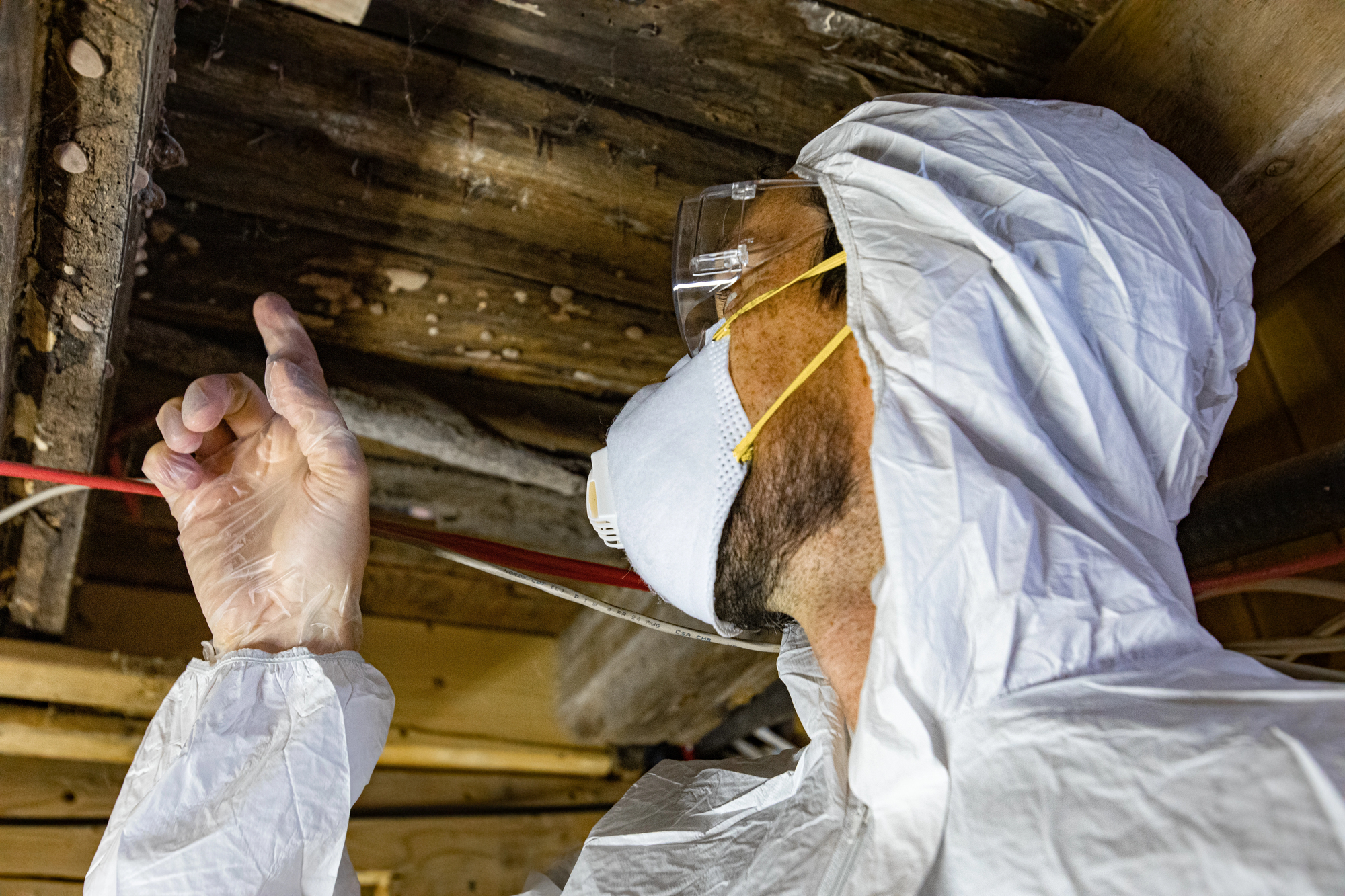
Booking a damp survey before you buy
If you’ve spotted issues with damp during viewings, or your Home Report recommends follow-up checks, it’s worth acting early. You can book a damp survey at any point before missives are concluded. That’s the moment the contract becomes binding and it’s too late for either side to have second thoughts.
Two practical points people tend to miss.
You’ll need permission for access. The property still belongs to the seller, so your solicitor or the selling agent has to arrange the damp inspection. Factor that into your timings.
“Subject to survey” comes with a trade-off. Your solicitor can add it to your offer as a non-standard clause, and it does protect you if the findings are serious. But sellers generally don’t like conditional offers, and in a competitive market, particularly where a closing date has been set, attaching one can cost you the property. It’s a far stronger option in a slow market than a hot one. Worth discussing with your solicitor before you offer rather than after.
Many firms now let you request quotes and check availability online, so you can effectively book a survey online in a few minutes. That’s fine. What matters is that the inspection itself happens on site and is properly evidenced.
Booking a damp survey in Scotland
We carry out damp and timber surveys across Scotland for buyers, sellers and homeowners, including pre-purchase inspections timed around missives. Request a survey and we’ll come back to you with availability and a fixed fee.
Quick checklist: do you need a damp survey?
You probably need a damp survey when:
- The Home Report flags dampness, rot or infestation, or recommends further investigation
- You can see mould growth, musty smells, or repeated condensation and mould on windows and cold corners
- There are clear damp patches, tide marks, blown plaster, salt deposits or deteriorating timber
- The property is older, altered, or has solid walls, and you want confidence before purchase
- You’re budgeting renovation work and need to estimate the cost of dealing with damp accurately
- The Home Report is approaching 12 weeks old and the weather has turned since
Questions worth asking before you book
- Who will carry out the damp survey, and how much experience does that surveyor have with properties like yours?
- Does the fee cover a damp and timber survey, or damp only?
- Will the report include photographs and recorded readings?
- Do you sell or carry out remedial work, or is the survey independent?
- If the report recommends further investigation, is that included or extra?
- How long until I get the written report?
That last one matters more than it looks. Scottish transactions move quickly, and a report that lands after missives are concluded isn’t much use to you.
Final thought
A damp survey isn’t about scaring you off a purchase, it’s about clarity. In Scotland’s market, where you often move quickly from offer to conclusion of missives, having a qualified surveyor diagnose moisture properly can help you avoid the wrong fix, plan sensible repairs, and deal with damp issues effectively.
If you’d like a damp survey on a property you’re buying in Scotland, you can request a survey and we’ll talk you through what’s involved before you commit to anything.


